بررسی بمب های الکترو مغناطيسی و چگونگی مقابله با آنها
»» عنوان: بررسی بمب های الکترو مغناطيسی و چگونگی مقابله با آنها
»» این مقاله به صورت PDF در ۵۲ صفحه می باشد.
»» نام استاد: جناب استاد پیر مرادیان
»» تهیه کننده : دانشجوی جوان دانشگاه اسلامشهر : صادق R
»» حجم این مقاله در حدود ۶۵۰ کیلو بایت می باشد.
»» پسوورد این فایل ELEELE.BLOGFA می باشد.
»» برای مشاهده مقاله بدون تصویر روی ادامه مطلب کلیک کنید .
عنوان: بررسی بمب های الکترو مغناطيسی و چگونگی مقابله با آنها
نام استاد: جناب استاد پیر مرادیان
تهیه کننده : دانشجوی جوان صادق R
مشخصه گروه : 2494
...::: فهرست :::...
مقدمه.............................................................................................................................................................................................3
لزوم بررسی بمب های الکترو مغناطيسی .........................................................................................................................4،5
بمب الکترومغناطسی چه وقت و چگونه اختراع شد؟..................................................................................................... 6،7
بمب الکترومغناطیسی چیست و چگونه عمل می کند؟..................................................................................................8،9
تاثیرات پالس های الکترومغناطیسی................................................................................................................................... 10
کدام موج در نقش بمب ظاهر میشود؟............................................................................................................................ 11
اهمیت بمب الکترومغناطیسی از لحاظ نظامی ............................................................................................................12،13
به کار بردن منابع ارزان،مهندسی ارتش بنیادین ........................................................................................................14،15
آیا تا به حال از این سلاح استفاده شده است ؟ ............................................................................................................. 16
دفاع در مقابل بمب های الکترو مغناطیسی ............................................................................................................... 17،18
مایکل فارادی ....................................................................................................................................................................19،20
آشنایی با قفس فارادی ..........................................................................................................................................................21
اصول کلی حفاظت و مفهوم منطقه بندی حفاظتی ....................................................................................................... 22
حفاظت سيستم هاي الكترونيكي از مسير اتصال به خطوط تغذيه ............................................................................. 23
حفاظت تجهيزات الكترونيكي از مسير اتصال به خطوط ديتا، سيگنال و تلفن ...................................................... 24
حفاظت سيستمهاي مخابراتي از مسير اتصال به خطوط فركانس بالا (RF) ......................................................... 25
اطلاعاتی راجع به لباس های مردانه برای مقابله با امواج الکترو مغناطیسی ........................................................... 26
منابع استفاده شده ................................................................................................................................................................ 27
مقدمه
با عرض سلام خدمت استاد گرامی جناب استاد پیرمرادیان :
نظر به پیشرفت روز افزون علم الکترونیک و وابستگی همه جانبه و روز افزون مردم به این علم ،بر آن شدم تا به احتیاط به عاملی بپردازم که در نوع خود ممکن است این زنجیره وابستگی را مختل نماید و راههای پیشگیری از آن نیز مطرح نمایم .
بسیاری از وسایل پیرامون ما برای کارکردن به انرژی برق نیاز دارند و بخش عمده ای از زندگی ما به برق متکی است برخی از وسایل مانند تلویزیون ها ، رادیوها ، لامپ ها،گرم کننده های برقی و دستگاه های ارتباطی اعم از نظامی و شخصی... همگی به انرژی برق نیازدارند . حال تصور کنید در طول یک روز برق خانه شما قطع شود چراغ ها،تلویزیون،رادیو و دستکاههای تلفن و موبایل کار نمی کنند. بعد از مدتی از بیکاری به دور خود چرخ می زنید و پس از چند ساعت، ماندن درخانه برای شما طاقت فرسا خواهد شد. حال اگر چنین مشکلی را در مقیاس بزرگتر فرض کنیم این مشکلات هم بزرگتر می شوند. به عنوان مثال دریک شهر خدمات اجتماعی از قبیل اورژانس ، پلیس ، تجهیزات بیمارستانی و همه و همه از کار می افتند. مشکلاتی از این قبیل ممکن است حتی منجر به مرگ انسان هم شود. کارخانه های مواد غذایی بر اثر از کار افتادن سردخانه هایشان متحمل میلیون ها دلار ضرر می شوند و درصورتی که این وضعیت باقی بماند، نیروهای دولتی و خدمات دولت هم از کار خواهند افتاد.
با توجه به این گفته ها ، دیده می شود که یکی از نیاز های جدی بشر امروز انرژی الکتریکی است.
این مقوله از تازگی ویژه ای برخوردار است که آن را از لحاظ علمی منحصر به فرد می نماید. برای ساخت هر دارویی ابتدا باید بیماری را تشخیص داد و سپس از راههای درمان استفاده کرد .
در این مقاله چگونگی ساخت این مختل کننده های الکترو مغناطیسی(بمب های الکترو مغناطیسی)، نحوه عملکرد آنها ،خطرات پس از استفاده از این سیستم ، و چگونگی دفاع در مقابل آن مورد بررسی قرار می گیرد.
بمب های الکترو مغناطیسی تنها در اختیار ایالات متحده امریکا قرار دارد و جهت مصارف نظامی از آن استفاده نموده است.ایالات متحده به خاطر این که این سلاح ها به هیچ وجه مرگ آور نیستند از شرح آن ها صرف نظر کرده ولی این سلاح ها به صورت جدی مخرب هستند. یک حمله با بمب برقاطیسی می تواند زندگی را در ساختمان ها فلج و نابود کند همچنین می تواند باعث نابودی یک ارتش بزرگ باشد.
لذا بررسی آن و پیشنهاد و بررسی راه کار های موجود در زمان صلح می تواند بسیار مفید باشد.
سلاح تخریب جمعی وسایل الکترونیکی: تکنیک تولید امواج الکترومغناطیسی توان بالا تا جایی پیشرفت کرده است که می توان از آن ها در (E-bombs) استفاده کرد . به منظور پاسخگویی نیازهای استراتژیک و تکنیکی در میدان جنگ. ساخت و بهبود (E-bomb) به کاربران اجازه می دهد که از آنها بیشتر در نبردهای غیر اتمی استفاده کنند.این مقاله در ارتباط با تکنولوژی های استفاده شده در ساخت این نوع سلاح ها ، چگونگی پرتاب جنگ افزار ، و آموزش به منظور استفاده از چنین سلاح هایی به عنوان سر جنگی (warhead)می باشد .
امید است این مقاله و مطالب موجود در آن مورد رضایت شما استاد گرامی واقع گردد.
لزوم بررسی بمب های الکترو مغناطيسی
انفجار یک میدان مغناطیسی بسیار نیرومند می تواند در کسری از ثانیه آن چنان قدرت الکتریکی بالایی را در کلیه مواد هادی پیرامون خود القا نماید، که به راستی تمام آنها را مختل نموده و از کار بیاندازد.
هر چند این میدان مغناطیسی بر روی جسم انسان به عنوان یک هادی الکتریکی نیز موثر می باشد. ولی این تاثیر بسیار محدود و مقطعی بوده و بدن جز در موارد خاصی قدرت مقاومت در برابر آن را دارد. در جنگ افزارهای نسل الکترونیک استفاده از سلاح مغناطیسی و فیزیک امواج الکترومغناطیسی جایگاه ویژه ای داشته و مورد توجه سازندگان این قبیل سلاحها بوده است.
کشور هند تحقیقات بسیار گسترده ای را در زمینه ی بمب های الکترومغناطيسی ساده وارزان «اف سی جی »به انجام رسانده که دلیل عمده ی آن،احتمال استفاد ه ی پاکستان از این گونه جنگ افزارها بر ضد این کشور است.ایالات متحده تمایل زیادی به استفاده از تکنولوژی بمب الکترومغناطيسی دارد.چون چنین جنگ افزارهایی مرگ آور نیستد ولی در عین حال بسیار مخرب و ویرانگرند .
البته بمب های الکترومغناطيسی سطح پایین و کوچک تنها می توانند مختصرا باعث ایجاد پارازیت در سیستم های الکترونیکی شوند ویا نهایتا کارآیی آنها را پایین بیاورند ولی سیستم های قدرتمند می توانند اطلاعات مهم کامپیوتری را از بین برده وسیستم های بسیار بزرگ نیز تجهیزات برقی و الکترونیکی را به آتش خواهند کشید.
روزی را تصور کنید که در یک شهر معمولی و در یک زمان تمام دستگاه های الکتریکی روشن و در حال کار ناگهانی سوخته و از کار بیافتد و تمام دستگاه های خاموش نیز در آن واحد روشن شده و پس از چند لحظه آنها نیز بسوزند. در چنین شهری پس از انفجار بمب الکترومغناطیسی بر فراز شهر ، در کسری از ثانیه یک تا دو میلیارد وات انرژی الکتریکی کلیه سیستم های مخابراتی و رادیویی و تلویزیونی را از کار بیاندازد.
برق شهر قطع می گردد، مدار الکتریکی همه رایانه ها می سوزد. تمام باتریها و خازن ها منفجر می شوند. لامپ تصویر همه تلویزیون هاو مانیتورهای خاموش یا روشن نورانی شده و می سوزد. همه موتور الکتریکی با آخرین دور ، همه و همه از کار می افتند و ناگهان شهر در قهقرا فرو می رود.
سیستم های گرمازایی و سرمازایی ، پمپ های آب و حتی ساعتهای مچی نیز از کار می افتند. شهر بدون الکتریسیته ، موتور ، باتری ، مخابرات و حرکت کاملا فلج می شود. همه این اتفاقات با سرعت نور یعنی کسری از ثانیه پس از انفجار یک بمب الکترومغناطیسی در حوزه میدان مغناطیسی آن اتفاق می افتد. با این سلاح مغناطیسی را می توان یک اسلحه انسانی نیز به حساب آورد. چرا که به ساختمانها و انسانها کمترین آسیب را می رساند.
میدان مغناطیسی قوی نوسان دار می تواند جریان برق بسیار بزرگی را در هر جسم رسانای دیگر ایجاد نماید.این آنتن های اتفاقی وغیر عمد ،می توانند جریان برق را به تمامی وسایل برقی در ارتباط با خود انتقال دهند.مثلا یک شبکه ی کامپیوتری عظیم را در نظر بگیرید که توسط خطوط تلفن با یکدیگر در ارتباط هستند.در این صورت با به وجود آمدن جریان عظیمی در خطوط تلفن،تمامی شبکه نابود خواهد شد.یک موج بلند خیلی بزرگ می تواند وسایل نیمه رسانا را بسوزاند،سیم کشی ها را ذوب کند،باتری ها را از بین برده وحتی ترانسفورماتورها را منفجر نماید.
بمب الکترومغناطسی چه وقت و چگونه اختراع شد؟
طرز کار اصلی بمب های الکترومغناطیسی یا در مبحث بزرگترElectro Magnetic Pulse weapon (EMP) مبنای اسلحه های اتمی یا تکانه ی برقاطیسی بسیار ساده است این اسلحه ها با ایجاد میدان قوی الکترومغناطیسی تمام مدارات برقی را درهم می شکند . اگر با طرز کار آهنربا های برقی یا رادیو آشنا هستید پس حتماً می دانید که الکترومغناطیسی چیز ویژه و جدیدی نیست. سیگنال های تلویزیونی و امواج AM و FM رادیویی ، تلفن های همراه و چراغ های ماکروویو و امواج X-ray . مقصود ما این است که بفهمیم آیا آهن رباهای الکتریکی می توانند مولد میدان الکتریکی ای باشند که بتوان آن را به صورتی تغییر داد که بتواند موجب ایجاد الکتریسیته شود.
در ابتدا باید توضیح داد که یک فرستنده ی رادیویی ساده چگونه میدان الکتریکی که توسط افت و خیزهای متناوب تولید می شود، را می تواند به جریان برق دریک رسانای هم جوار دیگر تبدیل کند (مثل آنتن های گیرنده ی رادیوای ) یک فرستنده ی رادیویی می تواند امواج رادیویی را به صورت سیگنال به یک گیرنده برساند حال اگر سیگنال ها را قوی و پرانرژی کنیم (میدان مغناطیسی) می تواند به مقدار زیادی الکتریسیته تبدیل شود. یک موج قوی می تواند یک قطعۀ نیمه رسانا دریک رادیو را بسوزانند و یاآن هارا فراتر از آن که قابل تعمیر باشد از هم بپاشند...!!! بنابرین خریدن یک رادیوی جدید می تواند ساده و راحت ترین کار برای حل این مشکل باشد .
نوسانات شدید میدان مغناطیسی می تواند موجب به وجود آمدن برق زیادی در هر نوع وسیله ی رسانای دیگر شود، به عنوان مثال خطوط تلفن، خطوط انتقال قدرت و حتی لوله های هوای فلزی. این امواج می توانند به طور غیر عمدی هر وسیله ی الکتریکی که در طیف امواجشان قرار گیرد، از جمله شبکه های کامپیوتری که به خطوط تلفن وصل شده اند را از کار بیندازد، یک موج قوی تر و بزرگتر می تواند دستگاه های نیمه رسانا را بسوزاند، سیم کشی ها را ذوب کند، باتری ها را منفجر کند و حتی مبدل های الکتریکی را هم نابود کند. راه های زیادی برای تولید و آزاد سازی چنین میدان های مغناطیسی وجود دارد. حال نگاهی به چند راه ممکن برای ساخت اسلحه های (EMP ) می اندازیم. با توجه به این که اندیشه ساخت اسلحه های (EMP ) مدت ها است که وجود دارد چند سالی بیشتر نیست که همه ی نگاه ها را به خود متوجه کرده است و در سر فصل مقاله ها و عناوین جایی برای خود باز کرده . در طی سال های 1960 تا1980،آمریکا نگران ترین کشوری بوده است که متوجه خطر حمله های الکترومغناطیسی اتمی بود .
اندیشه ونقطةعطف تحقیقات هسته ای به سال1950 بر می گردد در سال 1958آمریکایی ها اولین بمب هیدروژنی خود را امتحان کردند که نتایج بسیار خارق العاده ای را برای آنها همراه داشت. امتحان یک انفجارهسته ای به روی اقیانوس آرام باعث شد که از طرفی لامپ های بخش هایی از جزایر هاوایی منفجر شوند و از طرفی دیگر هزاران مایل دورتر یعنی در استرالیا بسیاری از تجهیزات رادیویی آنان منفجر گردد .
محققان نشان دادند که درهم ریختگی الکتریکی به دلیل اثرات این انفجار بوده است. تئوری که در سال 1925توسط فیزیک دانی داده شده بود مبنی بر این بود که فتون های انرژی الکترومغناطیسی می توانند الکترون های موادی را که دارای عدد اتمی کمی هستند با ضربه ی اندکی از اتم جدا کنند .
در آزمایشی که در سال 1958 انجام شد محققان نتیجه گرفتند فتون هایی را که از انفجار شدید تشعشعات گاما به وجود می آید، مقدار بسیار زیادی از الکترون های اتم های اکسیژن و نیتروژنی که در جو زمین وجود دارند را جدا می کند. این سیل عظیم الکترون ها هم کنشی با میدان مغناطیسی زمین برای بوجود آوردن یک جریان الکتریکی متغییر داشتند که موجب ایجاد یک میدان مغناطیسی بسیار قوی گردید.
پالس الکترومغناطیسی حاصل ، یک جریان الکتریکی قوی در سطحی بسیار گسترده به وجود می آورد.
در زمان جنگ سرد سازمان اطلاعات ایالات متحده از این موضوع می ترسید که اتحاد جماهیر شوروی موشک اتمی 50 کیلومتر بالاتر از سطح ایالات متحده پرتاب کند و به نتایج نظریۀ اشاره شده در مقیاس وسیع دست پیدا کند. آن ها از این می ترسیدند که انفجار الکترومغناطیسی حاصله ، تمام ابزارهای الکتریکی را در سراسر ایالات متحده از بین ببرد.
هنوز احتمال چنین حمله ای به دیگر ملت ها وجود دارد اما این موضوع دیگر مسئله ی اصلی و مورد توجه ایالات متحده نیست.امروزه سازمان اطلاعات ایلات متحده به دستگاه های غیر اتمی EMP مانند E-BOMB اهمیت بیشتری می دهد. این سلاح ها به اندازه ی بمب اتم، منطقه ی گسترده ای را تحت تاثیر قرار نمی دهد. چون آن ها فوتون ها را در ارتفاع زیادی از سطح زمین منفجر نمی کنند. اما می توانند برای ایجاد خاموشی کامل در سطح محلی به کار روند...
بمب الکترومغناطیسی چیست و چگونه عمل می کند؟
بمب الکترومغناطیسی در واقع چیزی نیست جز یک شار مغناطیسی فوق العاده ای نیرومند که با گسیل فیزیک امواج پر قدرت (SHF) سوپر فرکانس های با طول موج بالاتر از ده گیگا هرتز موسوم به امواج میکروویو پر قدرت
(High Power Microwave) می تواند هر گونه دستگاه های الکتریکی یا الکترونیکی واقع در محدوده عمل خود را در یک باند فوق گسترده (UWB) که مخفف عبارت Ultra Wide Band می باشد، فلج نماید.
E-Bomb به سال 1945 بر می گردد. فیزیکدانی به نام آرتور . اچ. کامپتون روی جریان خروجی الکترونهای اتم مطالعه می کرد که امروز به اثر کامپتون معروف می باشد. بعد ها اثر کمپتون در قالب تکانهای الکترومغناطیسی به طراحی انواع سلاح های الکترومغناطیسی مختلف انجامید. برای شناخت E-Bomb باید ابتدا با یک تانک LC آشنا شویم.
تانک LC چیزی نیست جز یک مدار ساده نوسان ساز که از یک سلف یا سیم پیچ و یک خازن و یک باتری تشکیل شده است. در تانک LC یک فرکانس میرا تولید می گردد که اگر یک کلید قطع و وصل الکترونیکی به آن اضافه نماییم، بسته به قدرت فرکانس سازی یک فرکانس رادیویی کریر یا حامل خواهیم داشت. هر چند مدار الکترونیکی قابلیت تولید فرکانس در محدوده های مختلف را داراست، لیکن نیاز به یک مدار طبقه تقویت نیز دارد تا قدرت فرستندگی آن افزایش یابد.
لذا باید سر راه آن یک تقویت کننده ترانزیستوری قدرت نیزه بهره جست که باز بسته به توان خروجی ترانزیستور طبقه تقویت قدرت فرستنده افزایش می یابد. قدرت یک فرستنده بستگی به توان خروجی آن دارد. معمولا فرستنده های 5 وات یا بالاتر از آن فرستنده های نیرومند به حساب می آیند، به نحوی که اگر انسان در کنار آنها قرار گیرد برای سلامتی وی مضر خواهد بود.
حال آنکه می توان با افزایش طبقات تقویت قدرت فرستندگی فیزیک امواج را بسیار بالا برد. اما این تنها بخش الکترومغناطیسی بمب الکتریکی می باشد، در حالیکه این بمب مثل هر بمب دیگری دارای واحد بخش انفجاری نیز می باشد. این قسمت یک بمب کاملا کلاسیک و عادی است.
در واقع بخش اصلی بمب الکترومغناطیسی یک لوله تو خالی رسانا است، که حکم هسته سیم پیچ بمب را نیز دارد و در داخل این هسته مواد منفجره و چاشنی الکتریکی قراردارد که درست در لحظه انفجار بمب مدار الکتریکی نیز بکار می افتد و میدان مغناطیسی حاصل از کارکرد مدار الکترونیکی در یک میدان انفجاری قرار گرفته و انفجار میدان الکترومغناطیسی رخ می دهد.
همزمانی انفجار بمب و بکار افتادن مدار نوسان ساز بسیار مهم می باشد. زیرا آنچه موجب تقویت امواج الکترومغناطیسی باور نکردنی و ارسال فیزیک امواج الکترومغناطیسی در همه جهات می گردد وقوع انفجار در مرکز میدان مغناطیسی می باشد همچنین از دیگر نکات حائز اهمیت در E-Bomb جهت سیم پیچ است که با عنایت با قانون دست راست فلمینگ می توان جهت شار مغناطیسی را متناسب با شکل سیم پیچ ، تعیین نمود.
دستگاهی به نام ویراکتور(Vircator) در ساخت بمب ها استفاده می شود،دستگاهی که در آن واحد قادر به تولید یک پالس بسیار قوی می باشد . این دستگاه از نظر مکانیکی بسیار ساده است و می تواند در طیف وسیعی از امواج مایکرو ویو تاثیر گذار باشد .
طرز کار اصلی این دستگاه از دستگاههای الکترونیکی امروزه پیچیده تر است.شالوده آن بر اساس سرعت بخشیدن به یک باریکه الکترون های جریان بالا در مقابل یک روزنه (آند) است ،تعداد زیادی از الکترونها از آند عبور خواهند کرد و به شکل یک حباب بار فضای پشت آند را می پوشانند، در شرایط مناسب این بارها این محدوده از بارها در فرکانس های مایکروویو نوسان خواهند کرد .اگر این محدوده بارها در یک کوتی(cavityنوعی انتقال دهنده امواج با فرکانس و توان بالا است) که به درستی تیون شده قرار بگیرند ،پیک های بسیار بالایی بدست خواهند آمد . مهندسین ساخت این بمب ها از امواج را از کوتی رزونانس جدا می کنند .به دلیل اینکه نوسان سازی به پارامترهای اولیه بیم بستگی دارد ،لذا ویراکتورها را می توانند نسبت به فرکانس خاصی تنظیم کنند جایی که کوتی ها بهترین حالت را ارائه می دهند و حمایت می کنند.
در تحقیقات صورت گرفته سطح توان بدست آمده از ویراکتورها از 170 kiloWatts الی 40 GigaWattsدر تمام فرکانس های decimetric و centimetricبه دست آمده است.
برای مشاهده متن تخصصی به قسمت انگلیسی ویراکتور مراجعه نمایید.
تاثیرات پالس های الکترومغناطیسی
سایر دستگاههای الکترونیکی ممکن است با تاثیرات EMP تخریب شوند . دستگاههای ارتباطی ممکن است کاملا صدمه بینند توسط کابل های مسی که بین دستگاهها متصل هستند .در قسمت ریسیو دستگاهها بسیار به EMP حساس هستند ،به عنوان مثال ترانزستورهای کوچک و حساس و دیود ها در چنین دستگاههایی به سادگی با اعمال زود گذر ولتاژ الکتریکی بالا آسیب می بینند . و همچنین رادار ها و تجهیزات جنگی الکترونیک ،ماهواره ها ،سیستم های مایکرو ویو ، UHF, VHF, HF، و تجهیزات ارتباطی باند کوتاه ، و تجهیزات تلویزیونی شدیدا با تاثیرات EMP آسیب می بینند.
دستگاههای نظامی به خوبی محافظت شده هستند ولی امواج EMP می تواند از کارایی آنها بکاهد و یا آنها را کاملا بلا استفاده کند.
متد های انتقال این امواج:
روش هایی که این توان ها به اهداف منتقل می شوند.
روش انتقال Front Door زمانی اتفاق می افتد که امواج از اسلحه الکترومغناطیسی کوپل می شوند به یک آنتن مثل آنتن رادار یا تجهیزات ارتباطی . یک آنتن طراحی شده است تا کار یک فرستنده و گیرنده را انجام دهد و این موضوع راهی مناسب برای این را فراهم می کند تا انرژی از طریق آن شارش بیابد و تجهیزات را دچار آسیب نماید .
روش انتقال Back Door وقتی اتفاق می افتد که میدان الکترو مغناطیسی از یک اسلحه پیک لحظه ای جریان را به وجود می آورد مثل termed spikes که توسط سلاح های فرکانس پایین تولید می شوند یا امواج ایستای الکتریکی(electrical standing waves) وقتی که توسط یک اسلحه HPM weapon تولید می شوند بر روی سیم ها و کابل هایی که وارد سیستم می شوند یا اینکه به منبه تغذیه وصل می شوند و یا اینکه به شبکه تلفن متصل می شوند. از این طریق امواج یه داخل نفوذ می کنند و به تجهیزات داخلی صدمه می زنند .
تجهیزات ارتباطی و پاور سوپلای ها باید مجهز شوند به رگولاتور ها . این چنین تجهیزاتی باید توسط ترانس های ایزوله گر از رنج 100 الی 3 کیلو ولت محافظت شوند.
کدام موج در نقش بمب ظاهر میشود؟
بزودی این نکته روشن شد که مناسبترین امواج الکترومغناطیسی برای ساخت بمبهای الکترومغناطیسی ، امواج با فرکانس در حدود گیگا هرتز است. این نوع امواج قادرند به درون انواع دستگاههای الکترونیک نفوذ کنند و آنها را از کار بیندازند. برای تولید امواج با فرکانس گیگاهرتز نیاز به تولید پالسهای الکترونیکی بود که تنها 100 پیکو ثانیه تدوام پیدا کنند. یک شیوه تولید این نوع پالسها استفاده از دستگاهی به نام «مولد ژنراتور مارکس» بود. این دستگاه عمدتا متشکل است از مجموعه بزرگی از خازنها که یکی پس از دیگری تخلیه میشوند و نوعی جریان الکتریکی موجی شکل بوجود میآورند.
با گذراندن این جریان از درون مجموعهای از کلیدهای بسیار سریع میتوان پالسهایی با دوره زمانی 300 پیکوثانیه تولید کرد. با عبور دادن این پالسها از درون یک آنتن ، امواج الکترومغناطیسی بسیار قوی تولید میشود. مولدهای مارکس سنگین هستند اما میتوانند پشت سرهم روشن شوند تا یک سلسله پالسهای قدرتمند را به صورت متوالی تولید کنند. این نوع مولدها هم اکنون در قلب یک برنامه تحقیقاتی قرار دارند که بوسیله نیروی هوایی آمریکا کانزاس در دست اجراست.
این شکل خواص اولیه این تکنولوژی را نشان می دهد.
اهمیت بمب الکترومغناطیسی از لحاظ نظامی
از لحاظ نظامی یک بمب الکترومغناطيسی می تواند باعث خنثی کردن مهمترین نیازهای طرف مقابل در صحنه ی نبرد باشد چنین بمبی می تواند سیستمهای کنترل وسایل نقلیه ی مختلف را از کار انداخته ،سیستمهای هدف یابی موشک ها وبمب ها را از بین ببرد.
وسایل ارتباطی را نابود سازد. سیستمهای مختلف هدایت عملیات طرف مقابل را از کار انداخته وسنسورهای مختلف پیچیده را خنثی نماید .بمبهای الکترومغناطیس بهترین گزینه برای حمله به پناه گاههای زیر زمینی طرف مقابل هستند.زیرا چنین سنگرهایی به وسیله ی موشک ها وبمب های معمولی، قابل انهدام نیستند.یک پالس الکترومغناطیسی رها شده از یک بمب الکترومغناطيسی می تواند از لایه های زمین عبور کرده وموجب قطع برق آن پناهگاهها شود.سیستم های تهویه را از کار انداخته ،ارتباط با بیرون را قطع کند وحتی در پناه گاههای پیشرفته ،درهای الکتریکی را از کار بیندازد.در حالی که E-Bomb هاجنگ افزار های مرگ آور به حساب نمی ایند ولی گاهی از اوقات می توانند یکی از عوامل کشته شدن افراد باشند.برای مثال اگر یک بمب E-Bomb باعث قطع برق یک بیمارستان شود،بیماران بسیاری در عرض چند ثانیه کشته خواهند شد .
همچنین یک E-Bomb می تواند باعث اختلال در حرکت تمامی وسایل نقلیه از جمله هواپیماها شود ویک فاجعه ی انسانی از سقوط هواپیما به وقوع بپیوندد.دور از ذهن ترین اثر بمب الکترومغناطيسی را می توان اثرات روانی آن دانست.یک حمله ی E-Bomb بزرگ در کشوری بزرگ می تواند یک زندگی مدرن قرت بیست ویکمی را 200 سال به عقب بازگرداند و آدمی را با زندگی جدیدی رو به رو سازد.تعداد بیشمار بازماندگان حمله ی E-Bomb ، خود را اسیر دنیایی عجیب وغیر قابل باور خواهند دید.دنیایی بدون امکان استفاده از نیروی برق.
به دلیل اینکه اسلحه های الکترو مغناطیس بسیار تاثیر گذار تر از سلاح های فرکانس پایین هستند ، لذا دستگاههای بای پس کننده کوپل فرکانس بی تاثیر هستند و این قبیل سلاح ها مهلک تر از سلاح های فرکانس پایین هستند.
در شکل بالا شماتیک کلی این سلاح را مشاهده می فرمایید.
تحقیقاتی که در این زمینه صورت گرفته است اهمیت دفاع و مقاوم سازی در مقابل این سلاح را نمایان می کند و استراتژی هایی را برای مقاوم سازی تجهیزات الکترونیک پیش روی ما فراهم می کند.
به کار بردن منابع ارزان،مهندسی ارتش بنیادین
یک سازمان تروریستی می تواند به سادگی یک بمب e-bomb خطرناک بسازد. در اواخر ستامبر2001 مهندس های طراز اول یک مقاله در مورد احتمال وجود این ابزار نوشتند. این مقاله به روی ژنراتورهای شارش متراکم که فکر اولیه آن ها به سال 1950 برمی گردند توجه کرده بود و در مورد e-bomb های قدرتمند ارزان قیمت توضیحاتی داده بود.
اندیشه ی بزرگ ساخت این وسیله، واقعأ برای نیروهای دولتی برای مدتی مهم بود. البته هیچ کس قادر به ساخت دستگاه
e-bomb با این توضیح به تنهایی نخواهد بود. بمب شامل یک سیلندر فلزی است که به عنوان آرمیچر توسط یک حلقه ی مارپیچ از سیم پیچ نگهداری شده است . سیلندر آرمیچر، با مواد منفجره ی قوی و یک پوشش قوی بیرونی که تمامی دستگاه را پوشانده است احاطه شده است.
در این قسمت ترتیب رخدادهایی را که برای انفجار بمب رخ می دهد را می توانید ببینید
موتور، سیلندر را که به طور مجزا دریک محیط خلأقراردارد ،می چرخاند. بمب همچنین منشأ قدرتی دارد(مثل خازن) که میتواند به مسیر سیم پیچ وصل شود.
یک سوئیچ به خازن وصل شده . بخش متحرک سیم پیچ الکتریسیته ی جاری را به سیمها منتقل می کند. این ژنراتورها میدان مغناطیسی بسیار قوی دارند . مکانیزم ساده ی یک فیوز مواد منفجره را فعال می کند .
انفجار به صورت موج از وسط سیلندر آرمیچر عبور می کند، این موج انفجار از وسط سیلندر در تماس با سیم پیچ ساکن قرار می گیرد . Stator Winding این یک دوره چرخش در حوزه ی قلمرو مدار می سازد که استاتور را از منبع تغذیه خود قطع می کند. چرخش کوتاه استاتور باعث ایجاد میدان مغناطیسی فشرده می شود که در نتیجه یک انفجار الکترومغناطیسی قوی را به وجود می آورد.بیشتر این اسلحه ها می توانند تا اندازه ی کوچکی منطقه ای را تحت تأثیر خود قرار دهند البته نه به اندازه ی حمله ی بمب های الکترومغناطیسی اتمی ولی می تواند خسارات جدی وارد کند.
ایالات متحده به خاطر این که این اسلحه ها به هیچ وجه مرگ آور نیستند از شرح آن ها صرف نظر کرده ولی این اسلحه ها به صورت جدی مخرب هستند. یک حمله با بمب برقاطیسی می تواند زندگی را در ساختمان ها فلج و نابود کند همچنین می تواند باعث نابودی یک ارتش بزرگ باشد.
مین مغناطیسی: هدف این برنامه جای دادن مولدهای مارکس روی هواپیماهای بدون خلبان یا در درون بمبها و موشکهاست تا از این طریق نوعی «میدان مین الکترومغناطیسی» برای مقابله با دشمن ایجاد شود. اگر هواپیما یا موشک دشمن از درون این میدان مین الکترومغناطیسی عبور کند، بلافاصله نابود خواهد شد. اگر لازم باشد تنها یک انفجار عظیم به انجام رسد، به دستگاهی نیاز است که بتواند یک پالس الکترونیکی بسیار قدرتمند را بوجود آورد؛ این کار را میتوان با استفاده از مواد منفجره متعارف نظیر «تی . ان . تی» انجام داد. دستگاهی که این عمل را به انجام میرساند، «متراکم کننده شار» نام دارد.
در اینجا انواع سناریو های ممکن برای حمله های مختلف وجود دارد.
پالس های میدان مغناطیسی سطح پایین می توانند به طور موقت سیستمهای الکتریکی را از کار بیندازد . پالس های قوی تر می توانند برنامه های کامپیوتری را خراب کنند ونیز انفجار های خیلی قدرتمند می تواند به طور کلی وسایل و تجهیزات الکتریکی را از کار بیندازد.
در جنگاوری مدرن سطوح مختلفی از حملات انجام می شوند تعدادی از عملیات های مهم جنگ را بدون زخمی و شکنجه کردن نیروها انجام دهند. به عنوان مثال e-bomb می تواند به طور مؤثر،تحرکات نظامی دشمن رامتوقف سازد.
سیستم های کنترلی وسایل نقلیه
هدف قرار دادن سیستم های زمینی بر روی بمب ها و موشک ها
سیستم های ارتباطی
سیستم های راه بری ، ناوبری، هدایت ، تعیین مسیر
سیستم های سنسور بلند یا کوتاه(رادارها)
آیا تا به حال از این سلاح استفاده شده است ؟
به اعتقاد برخی کارشناسان به نظر میرسد کشورهای پیشرفته پیشاپیش چنین سلاحی را تکمیل کردهاند و حتی برخی بر این باورند که ناتو در جریان جنگ علیه صربستان از این قبیل بمبها برای تخریب دستگاههای رادار صربها بهره گرفته است.
یک e-bomb می تواند مخصوصاً در مواردی مانند تهاجم به عراق موًثر باشد.در عراق چه اتفاقی رخ داد؟
پالس ها می توانند روی خنثی کردن زاغه های مهمات زیرزمینی تأثیرگذار باشند.پالس های الکترومغناطیسی زاغه ها را از کارانداختند ، همچنین چراغ ها و سیستم های تهویه ی هوا، ارتباطات و از جمله درهای الکترونیکی را از کار انداختند ، از یک حمله ی گسترده الکترومغناطیسی در عراق برای قطع ارتباط مراکز فرماندهی با مناطق عملیاتی استفاده شد.توانایی سازماندهی نیروهای عراق را به خطر انداخت .
برق بیمارستانها از کار افتاد و اتاق عمل ها و کلیه دستگاههای الکترونیکی بلافاصله ناتوان شدند.
مهم ترین تأثیر جانبی e-bomb عامل روانی آن بود، یک حمله ی کامل ودر سطح بالای الکترومغناطیسی درکشور عراق در مدت زمان اندک زندگی مدرن را به یک وقفه ی آزار دهنده تبدیل کرد.
همه زنده می مانند ولی آن ها خودشان را در یک دنیای کاملا متفاوت پیدا کردند . دنیایی بدون برق و الکتریسیته ... !!!
دفاع در مقابل بمب های الکترو مغناطیسی
موثر ترین دفاع در مقابل electromagnetic bombs جلوگیری از پرتاب آنهاست مثل جلوگیری از پرتاب موشک توسط جنگنده اما این امر همیشه ممکن نخواهد بود پس دستگاههای که انتظار می رود تا در مقابل فشار تاثیرات electromagnetic weapons باید کاملا مقاوم شوند.
موثر ترین روش قرار دادن تجهیزات در قفس فارادی می باشد .که از ورود میدان مغناطیسی به داخل تجهیزات جلوگیری می کند و در عین حال تجهیزات باید با دنیای بیرون ارتباط داشته باشند مانند منبع نیرو که این می تواند باعث نقطه ورود امواج به چهار دیواری شود و آسیب برساند . استفاده از فیبر نوری به جای کابل راه موثر و مهمی است برای ارسال و دریافت اطلاعات که در مقابل امواج الکترو مغناطیسی موثرند ولی منابه نیرو قابل آسیب پذیری هستند.که استفاده از جزئیات زیر می تواند موثر باشد.
برای مشاهده متن تخصصی به قسمت Defence Against Electromagnetic Bombs مراجعه نمایید.
در این دستگاه از انفجار اولیه یک ماده منفجره متعارف برای فشرده کردن یک جریان الکتریکی و میدان الکترومغناطیسی تولید شده بوسیله آن استفاده میشود. زمانی که این جریان فشرده شد، به درون یک آنتن فرستاده میشود و یک موج الکترومغناطیسی بسیار قدرتمند از آنتن بیرون میآید. طرح تکمیل دستگاههای متراکم کننده شار از سوی نیروی هوایی آمریکا در ایالت نیو مکزیکو در دست تکمیل است. از جمله طرحهایی که برای کاربرد این دستگاه در نظر گرفته شده ، جای دادن آنها در بمبهایی است که از هواپیما به پایین پرتاب میشود و نصب آنها در موشکهای هوا به هواست.
امتیاز بزرگ بمبهای الکترومغناطیسی
نخست آنکه این بمبها مستقیما جان انسانها را به خطر نمیاندازد و تنها بر دستگاههای الکترونیک اثر میگذارد.
نکته دوم آنکه ساخت آنها بسیار ساده است.
همچنین بمبهای الکترومغناطیسی در صورتی میتوانند بالاترین خسارت را وارد آورند که فرکانس امواجشان با فرکانس دستگاههایی که به آنها وارد میشوند یکسان باشد.
بنابراین برای ایجاد مصونیت در دستگاههای الکترونیکی که در مراکز حساس کار میکنند، میتوان طراحی مدارها را به گونهای انجام داد که اولا میان بخشهای مختلف ، سپرهای محافظتی موجود باشد و ثانیا در ورودی این قبیل دستگاهها باید صافیها و سنجندههایی را قرار داد که بتواند علامتهای مورد نیاز و امواج حاصل از انفجار را تشخیص دهند و مانع ورود این قبیل امواج شوند.
مایکل فارادی (۲۲ سپتامبر، ۱۷۹۱م - ۲۵ اوت، ۱۸۶۷م) دانشمندی (فیزیکدان و شیمیدان ) انگلیسی که با زمینههای الکترومغناطیس و الکتروشیمی مرتبط بود و چراغ بونزن را ابداع کرد بهترین روش برای دفاع در مقابل این نوع بمب ها دفاع الکترو مغناطیسی می باشد.
مایکل فارادی
تمامی جهان اذعان دارند که مایکل فارادی یکی از بزرگترین دانشمندان تاریخ بوده است. برخی از تاریخدانهای علم او را به عنوان بزرگترین تجربهگر در تاریخ علم میدانند. تبدیل شدن الکتریسیته به عنوان یک منبع انرژی حیاتی نیز بیشتر به علت تلاشهای او است.
زندگی
مایکل فارادی در نزدیکی الفنت و کستل، لندن به دنیا آمد. خانواده وی فقیر بودند و او مجبور بود که خودش درس بخواند. در چهارده سالگی او کارآموز یک صحافی و فروشگاه کتاب شد و در مدت هفت سال کارآموزیش کتابهای زیادی خواند که این امر علاقهاش را به علم زیاد کرد. در بیست سالگی او در سخنرانیهای دانشمند سرشناس هامفری داوی، رئیس انجمن رویال، شرکت کرد و به مباحث وی علاقهمند شد. پس از اینکه او نمونهای از نوشتههایش را به داوی ارسال کرد، داوری فارادی را به عنوان دستیارش استخدام کرد. در آن دوران فارادی فرد متشخصی شناخته نمیشد و گفته میشود که همسر داوی با او برخورد خوبی نداشت. به هر حال طولی نکشید که فارادی از داوی پیش افتاد.
کار علمی
بزرگترین کار وی با الکتریسیته بود. در سال ۱۸۲۱م، کمی بعد از اینکه شیمیدان دانمارکی، هانس کریستن اورستد، الکترومغناطیس را کشف کرد، داوی و ویلیام هید ولاستون سعی کردند تا یک موتور الکتریکی را طراحی کنند، اما نتوانستند. فارادی پس از صحبت با این دو نفر، تصمیم به ساخت دو وسیله برای تولید آنچه که او گردش الکترومغناطیسی (یک حرکت چرخشی پیوسته ناشی از نیروی مغناطیسی اطراف یک سیم) مینامید، گرفت. اگر یک سیم غوطهور در یک ظرف جیوه با یک آهنربا که در وسط آن قرار داده شده، با الکتریسیته تولید شده توسط یک باتری شیمیایی شارژ میشد، در اطراف آهنربا میچرخید.
این آزمایشها و ابداعات پایههای فناوری الکترومغناطیسی پیشرفته کنونی را ساختند. فارادی طی یک اقدام نابخردانه بدون اینکه از والستون و داوی بخاطر دینش نسبت به آنها، قدردانی کند نتایج آزمایشاتش را منتشر کرد و منازعه حاصل باعث شد که فارادی از تحقیقات الکترومغناطیسی برای سالها کنار بکشد. ده سال بعد در سال ۱۸۳۱م او سری بزرگ آزمایشاتش را که در آن به کشف القای الکترومغناطیسی نایل شد، آغاز کرد. او فهمید که اگر یک آهنربا را از وسط یک حلقه سیمی عبور دهد، یک جریان الکتریکی در سیم ایجاد میشود. دلایل او نشان داد که جریان الکتریکی مغناطیسم را ایجاد کرده است. سپس فارادی از این اصول برای ساخت دینامو، شکل قدیمی ژنراتورهای توان پیشرفته الکتریکی، استفاده کرد.
فارادی بیان داشت که نیروهای الکترومغناطیسی در فضای خالی اطراف هادی وجود دارد، اما او کارش را بر روی این پروژه تکمیل نکرد. تجسم آزمایشی فارادی از خطوط شار نشأت گرفته از بدنه بارها، برای بار اول بصورت ریاضی توسط قانون القای فارادی (که بعدا جزو معادلات ماکسول شد) مدل شد که در تعمیم کلی تکمیل شده و به عنوان تئوری میدان شناخته شده است. فارادی بصورت تفننی به شیمی نیز پرداخت و مواد شیمیایی نظیر بنزن را کشف و سیستم اعداد اکسیداسیون و میعان گازها را ابداع کرد. او همچنین قانون الکترولیز را کشف کرده و الفاظی نظیر آند، کاتد، الکترود و یون را عمومی ساخت.
در سال ۱۸۴۵م او آنچه را که اکنون اثر فارادی مینامیم و پدیدهای را که او دیامغناطیسم نامید، کشف کرد. سطح پلاریزاسیون نوری که بصورت خطی قطبی شده و از میان یک محیط مادی منتشر شده را میتوان توسط بکار گیری یک میدان مغناطیسی خارجی که در جهت انتشار تنظیم شده، چرخاند. او در دفترچهاش نوشت که من در نهایت در توصیف یک منحنی مغناطیسی یا خطوط نیرو و در مغناطیس کردن یک شعاع از نور موفق شدم. این نشان داد که نیروی مغناطیسی و نور به هم مرتبط هستند.
در کار روی الکتریسیته ساکن، فارادی نشان داد که بار تنها بر روی سطح خارجی یک هادی باردار قرار میگیرد و بار روی سطح خارجی هیچ اثری روی چیزی که داخل هادی قرار دارد، نمیگذارد. این اثر حفاظتی در آنچه که ما به عنوان قفس فارادی میشناسیم بکار رفته است.
موارد متفرقه
او یک سری سخنرانی موفق راجع به شیمی و فیزیک شعلهها در انستیتوی رویال ارائه داد که بنام تاریخ طبیعی شمع بود. این سخنرانیها، مبدأ سخنرانیهای کریسمس برای جوانان بود که هنوز هم همه ساله در آن مکان ارائه میشود. فارادی در طراحی آزمایشات معروف بود، اما فاقد تعلیم خوب ریاضیات بود. او آنقدر کم توقع و سخاوتمند شناخته میشد که مقام ریاست انجمن رویال (مقام پیشین داوی) را منحل کرد. واحد خازن، فاراد پس از او نام گذاری شده است و تصویر او روی اسکناس ۲۰ پوندی انگلیس چاپ شد.
فارادی متأهل بود اما فرزندی نداشت. حامی و مشاور او جان مدجک فولر بود که کرسی استادی فولرین شیمی را در موسسه رویال ایجاد کرد. فارادی اولین و معروفترین فرد دارنده این مقام بود که تا آخر عمرش برای این مقام انتخاب شد. او در منزلش در همپتون کورت در ۲۵ اوت ۱۸۶۷ میلادی درگذشت.
قفس فاراده درحقیقت قفسی است که در هنگام کار با ولتاژ های بالا مهندسین و تکنسینها را محافظت میکند . این قفس اولین بار توسط دانشمند معروف فارادی ساخته شد و بعد از آن اصول کار این قفس به همین نام یعنی قفس فاراده معروف شد.
این نوع قفس به دو شکل طراحی میشود :
قفس فاراده برای تجهیزات الکترونیک :
این قفس از شبکه های فلزی تشکیل شده که در چهار نقطه زمین میشوند . در اثر رانش ولتاژ بر سطح قفس ، توسط زمین دفع میشوند به این طریق هیچ آسیبی به افرادی که بیرون قفس قرار دارند نمیرسد . در آزمایشکاههای فشار قوی و تستینگ از این قفس بسیار استفاده میشود
قفس فاراده برای انسان :
این قفس معمولا از جنس فایبرگلاس و یا حتی فلز ساخته میشود که بدنه آن نسبت به زمین ایزوله میباشد . در نتیجه فردی که در این قفس قرار میگیرد هیچ گونه اختلاف پتانسیلی با زمین نخواهد داشت در نتیجه از برق گرفتگی مصون خواهد ماند .
اصول کلی حفاظت و مفهوم منطقه بندی حفاظتی
استاندارد IEC 61312-1 که در زمینه " حفاظت تجهیزات الکترونیکی داخل ساختمان در برابر صاعقه و اثرات مخرب ناشی از میدانهای الکترومغناطیسی" تدوین شده است، جهت طرح یک سیستم حفاظتی مناسب از تئوری منطقه بندی(Zone Concept) استفاده می کند. براساس این تئوری بیرون ساختمان که در معرض ضربه های مستقیم صاعقه قراردارد Zone0A و منطقه ای که احتمال اصابت مستقیم صاعقه وجود ندارد، اما شدت میدان الکترومغناطیسی (LEMP) بسیار بالاست، Zone0B و بخشهای داخلی ساختمان به ترتیب کاهش شدت میدان، Zone 1,2,… نامگذاری شده اند.
استانداردها، ماکزیمم جریان مورد انتظار برای یک صاعقه را 200 کیلوآمپر تعیین کرده اند. فرض شده که 50% این جریان از طریق سیستم ارتینگ به زمین منتقل و 50% بقیه، در همان زمان از مسیر خطوط هادی بشرح زیر، داخل ساختمان میشوند:
هادیهای برق
هادیهای سیستمهای کامپیوتری، مخابراتی و اطلاعاتی
لوله های آب، تهویه، آرماتورها، اسکلت فلزی ساختمان و . . .
حفاظت سيستم هاي الكترونيكي از مسير اتصال به خطوط تغذيه
(Surge Protection Devices for Power Systems)
استانداردهای IEC 61643-1 و VDE 0675-6/A براساس سطوح ولتاژ عایقی قابل تحمل تجهیزات (Impluse Withstand Voltage) که در IEC 60664-1 تعیین شده است، ارسترهای حفاظتی کلاس های I ،II ،III را طبقه بندی می نماید:
●محدود کننده جریان صاعقه (Lightning Current Arrester ) :
ارستر های کلاس ( I ) حفاظت
●محدود کننده های اضافه ولتاژ (Surge Arrester) :
ارستر های کلاس ( II ) حفاظت
●محدود کننده های اضافه ولتاژ (Surge Arrester) :
ارستر های کلاس ( III ) حفاظت
حفاظت تجهيزات الكترونيكي از مسير اتصال به خطوط ديتا، سيگنال و تلفن
(Yellow Line / Surge Protective Devices for Information Tech. System)
با انجام منطقه بندی حفاظتی(Zone Concept) در روند هم پتانسیل سازی و رعایت اصول EMC، علاوه بر خطوط تغذیه تجهیزات، میبایست سایر خطوط از جمله دیتا، تلفن وRF نیز مد نظر قرار گیرند.
محدود کننده جریان صاعقه(Lightning Current Arrester)
در حد فاصل Z1,Z0A نصب شده و از ورود بخشی از جریان مخرب صاعقه از طریق خطوط اطلاعاتی، به ساختمان جلوگیری میکند.
محدودکننده اضافه ولتاژ(Surge Arrester)
در حد فاصل Zone1و Zone2, 3 نصب شده و مدولهای ورودی و خروجی سیستمهای اطلاعاتی را در مقابل ولتاژهای (Surge) ناشی از صاعقه و سوئیچینگ محافظت مینماید.
حفاظتکننده BLITZDUCTOR
یکی از پرمصرفترین ارسترها در این بخش از حفاظت میباشد که دارای مشخصههای مختلف، از نظر تحمل انرژی است. این حفاظتکنندهها به گونهای ساخته شدهاند که بتوانند از تداخلات الکترومغناطیسی (EMI) برای تجهیزات مورد حفاظت جلوگیری کرده و ولتاژهای ضربه ورودی به تجهیزات را تا سطح ایمنی تجهیزات ( Immunity Level )کاهش میدهد.
حفاظت سيستمهاي مخابراتي از مسير اتصال به خطوط فركانس بالا (RF)
ضروري است در ايستگاه هاي مخابراتي، تجهيزات از مسير RF و تغذيه تواما حفاظت شوند. فركانس كار سيستم، امبدانس، مقدار مجاز VSWR و توان خروجي تجهيزات RX/TX، مشخصات ارستر مناسب را تعيين خواهند كرد. اين ارسترها با دو تکنولوژی "Gas Discharge Tube" GDT و نيز ¼ طول موج x/4 Shorting Stub ساخته شده اند.
اطلاعاتی راجع به لباس های مردانه برای مقابله با امواج الکترو مغناطیسی
زمانی که شما این لباسها را به تن می کنید در راحتی کامل به سر خواهید برد .این لباس ها شما را تا سطح 50 فوتی زیر آب نیز محافظت می کنند. این لباس از دو قسمت تشکیل شده است و در مقابل امواجی تا فرکانس 3.2 گیگا هرتز از شما محافظت می کند.
منابع استفاده شده:
http://www.abovetopsecret.com/pages/ebomb.html
http://tinwiki.org/wiki/Electromagnetic_Pulse_Bomb
http://www.cbsnews.com/stories/2003/03/25/iraq/main546081.shtml
http://tecfa.unige.ch/staf/staf-e/paraskev/staf15/how.html
IN THE NAME OF GOD :::.. ..:::
This Article Is Powered By Sadegh Aroodi Pour
And Is A Project For Electronic
To Have The Best Introduction Of This Product I Perform It In English & Farsi
Special Thanks To Dr PIRMORADIAN
The Source Of This Article Is From Internet Websites
See Our Weblog At http://eleele.blogfa.com
Electronic Engineers Of Islamshahr Univercity
Leave Your Comment To Make It Better Than Before
With Best Wishes For You SADEGH R
…::: Contents :::...
Electromagnetic Pulse Bomb……………………………………..…………….. 3
Introduction……………………………………………………………….…….......4
EMP Effect ……………………...………………………………………………….5
Technology Base for Conventional Electromagnetic Bombs ……………….. 6
Explosively Pumped Flux Compression Generators ………….…………… 7,8
Explosive and Propellant Driven MHD Generators ……………………….….. 9
High Power Microwave Sources - Vircator ………………………..…………..10
Lethality of Electromagnetic Warheads ……………………...………………. 11
Coupling Modes ………………………………………………..…………….12,13
Maximising Electromagnetic Bomb Lethality ………………………… 14,15,16
Targeting Electromagnetic Bombs ………………………...……………… 17,18
Delivery of Conventional Electromagnetic Bombs ………..…………….. 19,20
Defence Against Electromagnetic Bombs …………………………………21,22
Limitations of Electromagnetic Bombs ……………………………..………… 23
Proliferation of Electromagnetic Bombs ………………………..……………. 24
A Doctrine for the Use of Conventional Electromagnetic Bombs…….……. 25
Electromagnetic Pulse Bomb
A Weapon of Electronic Mass Destruction: High Power Electromagnetic Pulse generation techniques and High Power Microwave technology have matured to the point where practical Electromagnetic bombs (E-bombs) are becoming technically feasible, with new applications in both Strategic and Tactical Information Warfare. The development of conventional E-bomb devices allows their use in non-nuclear confrontations. This article discusses aspects of the technology base, weapon delivery techniques and proposes a doctrinal foundation for the use of such devices in warhead and bomb applications.
Introduction
The prosecution of a successful Information Warfare (IW) campaign against an industrialised or post industrial opponent will require a suitable set of tools. As demonstrated in the Desert Storm air campaign, air power has proven to be a most effective means of inhibiting the functions of an opponent's vital information processing infrastructure. This is because air power allows concurrent or parallel engagement of a large number of targets over geographically significant areas.
While Desert Storm demonstrated that the application of air power was the most practical means of crushing an opponent's information processing and transmission nodes, the need to physically destroy these with guided munitions absorbed a substantial proportion of available air assets in the early phase of the air campaign. Indeed, the aircraft capable of delivering laser guided bombs were largely occupied with this very target set during the first nights of the air battle.
The efficient execution of an IW campaign against a modern industrial or post-industrial opponent will require the use of specialised tools designed to destroy information systems. Electromagnetic bombs built for this purpose can provide, where delivered by suitable means, a very effective tool for this purpose.
EMP Effect
The ElectroMagnetic Pulse (EMP) effect was first observed during the early testing of high altitude airburst nuclear weapons. The effect is characterised by the production of a very short (hundreds of nanoseconds) but intense electromagnetic pulse, which propagates away from its source with ever diminishing intensity, governed by the theory of electromagnetism. The ElectroMagnetic Pulse is in effect an electromagnetic shock wave.
This pulse of energy produces a powerful electromagnetic field, particularly within the vicinity of the weapon burst. The field can be sufficiently strong to produce short lived transient voltages of thousands of Volts (ie kiloVolts) on exposed electrical conductors, such as wires, or conductive tracks on printed circuit boards, where exposed.
It is this aspect of the EMP effect which is of military significance, as it can result in irreversible damage to a wide range of electrical and electronic equipment, particularly computers and radio or radar receivers. Subject to the electromagnetic hardness of the electronics, a measure of the equipment's resilience to this effect, and the intensity of the field produced by the weapon, the equipment can be irreversibly damaged or in effect electrically destroyed. The damage inflicted is not unlike that experienced through exposure to close proximity lightning strikes, and may require complete replacement of the equipment, or at least substantial portions thereof.
Commercial computer equipment is particularly vulnerable to EMP effects, as it is largely built up of high density Metal Oxide Semiconductor (MOS) devices, which are very sensitive to exposure to high voltage transients. What is significant about MOS devices is that very little energy is required to permanently wound or destroy them, any voltage in typically in excess of tens of Volts can produce an effect termed gate breakdown which effectively destroys the device. Even if the pulse is not powerful enough to produce thermal damage, the power supply in the equipment will readily supply enough energy to complete the destructive process. Wounded devices may still function, but their reliability will be seriously impaired. Shielding electronics by equipment chassis provides only limited protection, as any cables running in and out of the equipment will behave very much like antennae, in effect guiding the high voltage transients into the equipment.
Computers used in data processing systems, communications systems, displays, industrial control applications, including road and rail signalling, and those embedded in military equipment, such as signal processors, electronic flight controls and digital engine control systems, are all potentially vulnerable to the EMP effect.
Other electronic devices and electrical equipment may also be destroyed by the EMP effect. Telecommunications equipment can be highly vulnerable, due to the presence of lengthy copper cables between devices. Receivers of all varieties are particularly sensitive to EMP, as the highly sensitive miniature high frequency transistors and diodes in such equipment are easily destroyed by exposure to high voltage electrical transients. Therefore radar and electronic warfare equipment, satellite, microwave, UHF, VHF, HF and low band communications equipment and television equipment are all potentially vulnerable to the EMP effect.
It is significant that modern military platforms are densely packed with electronic equipment, and unless these platforms are well hardened, an EMP device can substantially reduce their function or render them unusable.
Technology Base for Conventional Electromagnetic Bombs
The technology base which may be applied to the design of electromagnetic bombs is both diverse, and in many areas quite mature. Key technologies which are extant in the area are explosively pumped Flux Compression Generators (FCG), explosive or propellant driven Magneto-Hydrodynamic (MHD) generators and a range of HPM devices, the foremost of which is the Virtual Cathode Oscillator or Vircator. A wide range of experimental designs have been tested in these technology areas, and a considerable volume of work has been published in unclassified literature.
This paper will review the basic principles and attributes of these technologies, in relation to bomb and warhead applications. It is stressed that this treatment is not exhaustive, and is only intended to illustrate how the technology base can be adapted to an operationally deployable capability.
Explosively Pumped Flux Compression Generators
The explosively pumped FCG is the most mature technology applicable to bomb designs. The FCG was first demonstrated by Clarence Fowler at Los Alamos National Laboratories (LANL) in the late fifties. Since that time a wide range of FCG configurations has been built and tested, both in the US and the USSR, and more recently CIS.
The FCG is a device capable of producing electrical energies of tens of MegaJoules in tens to hundreds of microseconds of time, in a relatively compact package. With peak power levels of the order of TeraWatts to tens of TeraWatts, FCGs may be used directly, or as one shot pulse power supplies for microwave tubes. To place this in perspective, the current produced by a large FCG is between ten to a thousand times greater than that produced by a typical lightning stroke.
The central idea behind the construction of FCGs is that of using a fast explosive to rapidly compress a magnetic field, transferring much energy from the explosive into the magnetic field.
The initial magnetic field in the FCG prior to explosive initiation is produced by a start current. The start current is supplied by an external source, such a a high voltage capacitor bank (Marx bank), a smaller FCG or an MHD device. In principle, any device capable of producing a pulse of electrical current of the order of tens of kiloAmperes to MegaAmperes will be suitable.
A number of geometrical configurations for FCGs have been published. The most commonly used arrangement is that of the coaxial FCG. The coaxial arrangement is of particular interest in this context, as its essentially cylindrical form factor lends itself to packaging into munitions.
In a typical coaxial FCG , a cylindrical copper tube forms the armature. This tube is filled with a fast high energy explosive. A number of explosive types have been used, ranging from B and C-type compositions to machined blocks of PBX-9501. The armature is surrounded by a helical coil of heavy wire, typically copper, which forms the FCG stator. The stator winding is in some designs split into segments, with wires bifurcating at the boundaries of the segments, to optimise the electromagnetic inductance of the armature coil.
The intense magnetic forces produced during the operation of the FCG could potentially cause the device to disintegrate prematurely if not dealt with. This is typically accomplished by the addition of a structural jacket of a non-magnetic material. Materials such as concrete or Fibreglass in an Epoxy matrix have been used. In principle, any material with suitable electrical and mechanical properties could be used. In applications where weight is an issue, such as air delivered bombs or missile warheads, a glass or Kevlar Epoxy composite would be a viable candidate.
It is typical that the explosive is initiated when the start current peaks. This is usually accomplished with a explosive lense plane wave generator which produces a uniform plane wave burn (or detonation) front in the explosive. Once initiated, the front propagates through the explosive in the armature, distorting it into a conical shape (typically 12 to 14 degrees of arc). Where the armature has expanded to the full diameter of the stator, it forms a short circuit between the ends of the stator coil, shorting and thus isolating the start current source and trapping the current within the device.
The propagating short has the effect of compressing the magnetic field, whilst reducing the inductance of the stator winding. The result is that such generators will producing a ramping current pulse, which peaks before the final disintegration of the device. Published results suggest ramp times of tens to hundreds of microseconds, specific to the characteristics of the device, for peak currents of tens of MegaAmperes and peak energies of tens of MegaJoules.
The current multiplication (ie. ratio of output current to start current) achieved varies with designs, but numbers as high as 60 have been demonstrated. In a munition application, where space and weight are at a premium, the smallest possible start current source is desirable. These applications can exploit cascading of FCGs, where a small FCG is used to prime a larger FCG with a start current. Experiments conducted by LANL and AFWL have demonstrated the viability of this technique.
The principal technical issues in adapting the FCG to weapons applications lie in packaging, the supply of start current, and matching the device to the intended load. Interfacing to a load is simplified by the coaxial geometry of coaxial and conical FCG designs. Significantly, this geometry is convenient for weapons applications, where FCGs may be stacked axially with devices such a microwave Vircators. The demands of a load such as a Vircator, in terms of waveform shape and timing, can be satisfied by inserting pulse shaping networks, transformers and explosive high current switches.
Explosive and Propellant Driven MHD Generators
The design of explosive and propellant driven Magneto-Hydrodynamic generators is a much less mature art that that of FCG design. Technical issues such as the size and weight of magnetic field generating devices required for the operation of MHD generators suggest that MHD devices will play a minor role in the near term. In the context of this paper, their potential lies in areas such as start current generation for FCG devices.
The fundamental principle behind the design of MHD devices is that a conductor moving through a magnetic field will produce an electrical current transverse to the direction of the field and the conductor motion. In an explosive or propellant driven MHD device, the conductor is a plasma of ionised explosive or propellant gas, which travels through the magnetic field. Current is collected by electrodes which are in contact with the plasma jet.
The electrical properties of the plasma are optimised by seeding the explosive or propellant with with suitable additives, which ionise during the burn. Published experiments suggest that a typical arrangement uses a solid propellant gas generator, often using conventional ammunition propellant as a base. Cartridges of such propellant can be loaded much like artillery rounds, for multiple shot operation.
High Power Microwave Sources - Vircator
Whilst FCGs are potent technology base for the generation of large electrical power pulses, the output of the FCG is by its basic physics constrained to the frequency band below 1 MHz. Many target sets will be difficult to attack even with very high power levels at such frequencies, moreover focussing the energy output from such a device will be problematic. A HPM device overcomes both of the problems, as its output power may be tightly focussed and it has a much better ability to couple energy into many target types.
A wide range of HPM devices exist. Relativistic Klystrons, Magnetrons, Slow Wave Devices, Reflex triodes, Spark Gap Devices and Vircators are all examples of the available technology base [GRANATSTEIN87, HOEBERLING92]. From the perspective of a bomb or warhead designer, the device of choice will be at this time the Vircator, or in the nearer term a Spark Gap source. The Vircator is of interest because it is a one shot device capable of producing a very powerful single pulse of radiation, yet it is mechanically simple, small and robust, and can operate over a relatively broad band of microwave frequencies.
The physics of the Vircator tube are substantially more complex than those of the preceding devices. The fundamental idea behind the Vircator is that of accelerating a high current electron beam against a mesh (or foil) anode. Many electrons will pass through the anode, forming a bubble of space charge behind the anode. Under the proper conditions, this space charge region will oscillate at microwave frequencies. If the space charge region is placed into a resonant cavity which is appropriately tuned, very high peak powers may be achieved. Conventional microwave engineering techniques may then be used to extract microwave power from the resonant cavity. Because the frequency of oscillation is dependent upon the electron beam parameters, Vircators may be tuned or chirped in frequency, where the microwave cavity will support appropriate modes. Power levels achieved in Vircator experiments range from 170 kiloWatts to 40 GigaWatts over frequencies spanning the decimetric and centimetric bands.
The two most commonly described configurations for the Vircator are the Axial Vircator (AV) (Fig.3), and the Transverse Vircator (TV). The Axial Vircator is the simplest by design, and has generally produced the best power output in experiments. It is typically built into a cylindrical waveguide structure. Power is most often extracted by transitioning the waveguide into a conical horn structure, which functions as an antenna. AVs typically oscillate in Transverse Magnetic (TM) modes. The Transverse Vircator injects cathode current from the side of the cavity and will typically oscillate in a Transverse Electric (TE) mode.
Technical issues in Vircator design are output pulse duration, which is typically of the order of a microsecond and is limited by anode melting, stability of oscillation frequency, often compromised by cavity mode hopping, conversion efficiency and total power output. Coupling power efficiently from the Vircator cavity in modes suitable for a chosen antenna type may also be an issue, given the high power levels involved and thus the potential for electrical breakdown in insulators.
Lethality of Electromagnetic Warheads
The issue of electromagnetic weapon lethality is complex. Unlike the technology base for weapon construction, which has been widely published in the open literature, lethality related issues have been published much less frequently.
While the calculation of electromagnetic field strengths achievable at a given radius for a given device design is a straightforward task, determining a kill probability for a given class of target under such conditions is not.
This is for good reasons. The first is that target types are very diverse in their electromagnetic hardness, or ability to resist damage. Equipment which has been intentionally shielded and hardened against electromagnetic attack will withstand orders of magnitude greater field strengths than standard commercially rated equipment. Moreover, various manufacturer's implementations of like types of equipment may vary significantly in hardness due the idiosyncrasies of specific electrical designs, cabling schemes and chassis/shielding designs used.
The second major problem area in determining lethality is that of coupling efficiency, which is a measure of how much power is transferred from the field produced by the weapon into the target. Only power coupled into the target can cause useful damage.
Coupling Modes
In assessing how power is coupled into targets, two principal coupling modes are recognised in the literature:
Front Door Coupling occurs typically when power from a electromagnetic weapon is coupled into an antenna associated with radar or communications equipment. The antenna subsystem is designed to couple power in and out of the equipment, and thus provides an efficient path for the power flow from the electromagnetic weapon to enter the equipment and cause damage.
Back Door Coupling occurs when the electromagnetic field from a weapon produces large transient currents (termed spikes, when produced by a low frequency weapon ) or electrical standing waves (when produced by a HPM weapon) on fixed electrical wiring and cables interconnecting equipment, or providing connections to mains power or the telephone network. Equipment connected to exposed cables or wiring will experience either high voltage transient spikes or standing waves which can damage power supplies and communications interfaces if these are not hardened. Moreover, should the transient penetrate into the equipment, damage can be done to other devices inside.
A low frequency weapon will couple well into a typical wiring infrastructure, as most telephone lines, networking cables and power lines follow streets, building risers and corridors. In most instances any particular cable run will comprise multiple linear segments joined at approximately right angles. Whatever the relative orientation of the weapons field, more than one linear segment of the cable run is likely to be oriented such that a good coupling efficiency can be achieved.
It is worth noting at this point the safe operating envelopes of some typical types of semiconductor devices. Manufacturer's guaranteed breakdown voltage ratings for Silicon high frequency bipolar transistors, widely used in communications equipment, typically vary between 15 V and 65 V. Gallium Arsenide Field Effect Transistors are usually rated at about 10V. High density Dynamic Random Access Memories (DRAM), an essential part of any computer, are usually rated to 7 V against earth. Generic CMOS logic is rated between 7 V and 15 V, and microprocessors running off 3.3 V or 5 V power supplies are usually rated very closely to that voltage. Whilst many modern devices are equipped with additional protection circuits at each pin, to sink electrostatic discharges, sustained or repeated application of a high voltage will often defeat these.
Communications interfaces and power supplies must typically meet electrical safety requirements imposed by regulators. Such interfaces are usually protected by isolation transformers with ratings from hundreds of Volts to about 2 to 3 kV.
It is clearly evident that once the defence provided by a transformer, cable pulse arrestor or shielding is breached, voltages even as low as 50 V can inflict substantial damage upon computer and communications equipment. The author has seen a number of equipment items (computers, consumer electronics) exposed to low frequency high voltage spikes (near lightning strikes, electrical power transients), and in every instance the damage was extensive, often requiring replacement of most semiconductors in the equipment.
HPM weapons operating in the centimetric and millimetric bands however offer an additional coupling mechanism to Back Door Coupling. This is the ability to directly couple into equipment through ventilation holes, gaps between panels and poorly shielded interfaces. Under these conditions, any aperture into the equipment behaves much like a slot in a microwave cavity, allowing microwave radiation to directly excite or enter the cavity. The microwave radiation will form a spatial standing wave pattern within the equipment. Components situated within the anti-nodes within the standing wave pattern will be exposed to potentially high electromagnetic fields.
Because microwave weapons can couple more readily than low frequency weapons, and can in many instances bypass protection devices designed to stop low frequency coupling, microwave weapons have the potential to be significantly more lethal than low frequency weapons.
What research has been done in this area illustrates the difficulty in producing workable models for predicting equipment vulnerability. It does however provide a solid basis for shielding strategies and hardening of equipment.
The diversity of likely target types and the unknown geometrical layout and electrical characteristics of the wiring and cabling infrastructure surrounding a target makes the exact prediction of lethality impossible.
A general approach for dealing with wiring and cabling related back door coupling is to determine a known lethal voltage level, and then use this to find the required field strength to generate this voltage. Once the field strength is known, the lethal radius for a given weapon configuration can be calculated.
A trivial example is that of a 10 GW 5 GHz HPM device illuminating a footprint of 400 to 500 metres diameter, from a distance of several hundred metres. This will result in field strengths of several kiloVolts per metre within the device footprint, in turn capable of producing voltages of hundreds of volts to kiloVolts on exposed wires or cables. This suggests lethal radii of the order of hundreds of metres, subject to weapon performance and target set electrical hardness.
Maximising Electromagnetic Bomb Lethality
To maximise the lethality of an electromagnetic bomb it is necessary to maximise the power coupled into the target set.
The first step in maximising bomb lethality is is to maximise the peak power and duration of the radiation of the weapon. For a given bomb size, this is accomplished by using the most powerful flux compression generator (and Vircator in a HPM bomb) which will fit the weapon size, and by maximising the efficiency of internal power transfers in the weapon. Energy which is not emitted is energy wasted at the expense of lethality.
The second step is to maximise the coupling efficiency into the target set. A good strategy for dealing with a complex and diverse target set is to exploit every coupling opportunity available within the bandwidth of the weapon.
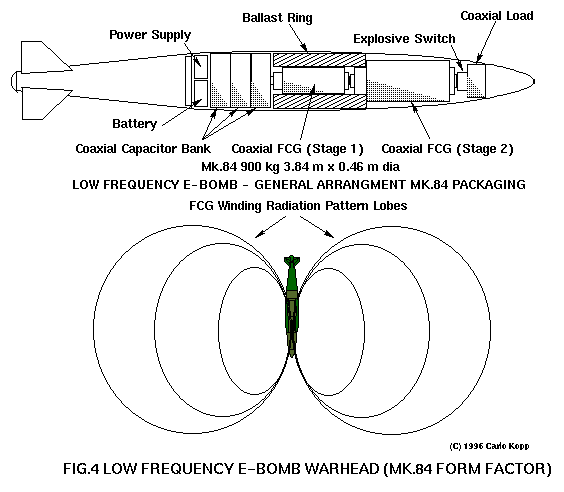
A low frequency bomb built around an FCG will require a large antenna to provide good coupling of power from the weapon into the surrounding environment. Whilst weapons built this way are inherently wide band, as most of the power produced lies in the frequency band below 1 MHz compact antennas are not an option. One possible scheme is for a bomb approaching its programmed firing altitude to deploy five linear antenna elements.
These are produced by firing off cable spools which unwind several hundred metres of cable. Four radial antenna elements form a "virtual" earth plane around the bomb, while an axial antenna element is used to radiate the power from the FCG. The choice of element lengths would need to be carefully matched to the frequency characteristics of the weapon, to produce the desired field strength. A high power coupling pulse transformer is used to match the low impedance FCG output to the much higher impedance of the antenna, and ensure that the current pulse does not vapourise the cable prematurely.
Other alternatives are possible. One is to simply guide the bomb very close to the target, and rely upon the near field produced by the FCG winding, which is in effect a loop antenna of very small diameter relative to the wavelength. Whilst coupling efficiency is inherently poor, the use of a guided bomb would allow the warhead to be positioned accurately within metres of a target. An area worth further investigation in this context is the use of low frequency bombs to damage or destroy magnetic tape libraries, as the near fields in the vicinity of a flux generator are of the order of magnitude of the coercivity of most modern magnetic materials.
Microwave bombs have a broader range of coupling modes and given the small wavelength in comparison with bomb dimensions, can be readily focussed against targets with a compact antenna assembly. Assuming that the antenna provides the required weapon footprint, there are at least two mechanisms which can be employed to further maximise lethality.
The first is sweeping the frequency or chirping the Vircator. This can improve coupling efficiency in comparison with a single frequency weapon, by enabling the radiation to couple into apertures and resonances over a range of frequencies. In this fashion, a larger number of coupling opportunities are exploited.
The second mechanism which can be exploited to improve coupling is the polarisation of the weapon's emission. If we assume that the orientations of possible coupling apertures and resonances in the target set are random in relation to the weapon's antenna orientation, a linearly polarised emission will only exploit half of the opportunities available. A circularly polarised emission will exploit all coupling opportunities.
The practical constraint is that it may be difficult to produce an efficient high power circularly polarised antenna design which is compact and performs over a wide band. Some work therefore needs to be done on tapered helix or conical spiral type antennas capable of handling high power levels, and a suitable interface to a Vircator with multiple extraction ports must devised. A possible implementation is depicted in Fig.5. In this arrangement, power is coupled from the tube by stubs which directly feed a multi-filar conical helix antenna. An implementation of this scheme would need to address the specific requirements of bandwidth, beamwidth, efficiency of coupling from the tube, while delivering circularly polarised radiation.
Another aspect of electromagnetic bomb lethality is its detonation altitude, and by varying the detonation altitude, a tradeoff may be achieved between the size of the lethal footprint and the intensity of the electromagnetic field in that footprint. This provides the option of sacrificing weapon coverage to achieve kills against targets of greater electromagnetic hardness, for a given bomb size (Fig.7, 8). This is not unlike the use of airburst explosive devices.
In summary, lethality is maximised by maximising power output and the efficiency of energy transfer from the weapon to the target set. Microwave weapons offer the ability to focus nearly all of their energy output into the lethal footprint, and offer the ability to exploit a wider range of coupling modes. Therefore, microwave bombs are the preferred choice.
Targeting Electromagnetic Bombs
The task of identifying targets for attack with electromagnetic bombs can be complex. Certain categories of target will be very easy to identify and engage. Buildings housing government offices and thus computer equipment, production facilities, military bases and known radar sites and communications nodes are all targets which can be readily identified through conventional photographic, satellite, imaging radar, electronic reconnaissance and humint operations. These targets are typically geographically fixed and thus may be attacked providing that the aircraft can penetrate to weapon release range. With the accuracy inherent in GPS/inertially guided weapons, the electromagnetic bomb can be programmed to detonate at the optimal position to inflict a maximum of electrical damage.
Mobile and camouflaged targets which radiate overtly can also be readily engaged. Mobile and relocatable air defence equipment, mobile communications nodes and naval vessels are all good examples of this category of target. While radiating, their positions can be precisely tracked with suitable Electronic Support Measures (ESM) and Emitter Locating Systems (ELS) carried either by the launch platform or a remote surveillance platform. In the latter instance target coordinates can be continuously datalinked to the launch platform. As most such targets move relatively slowly, they are unlikely to escape the footprint of the electromagnetic bomb during the weapon's flight time.
Mobile or hidden targets which do not overtly radiate may present a problem, particularly should conventional means of targeting be employed. A technical solution to this problem does however exist, for many types of target. This solution is the detection and tracking of Unintentional Emission (UE). UE has attracted most attention in the context of TEMPEST surveillance, where transient emanations leaking out from equipment due poor shielding can be detected and in many instances demodulated to recover useful intelligence. Termed Van Eck radiation, such emissions can only be suppressed by rigorous shielding and emission control techniques, such as are employed in TEMPEST rated equipment.
Whilst the demodulation of UE can be a technically difficult task to perform well, in the context of targeting electromagnetic bombs this problem does not arise. To target such an emitter for attack requires only the ability to identify the type of emission and thus target type, and to isolate its position with sufficient accuracy to deliver the bomb. Because the emissions from computer monitors, peripherals, processor equipment, switchmode power supplies, electrical motors, internal combustion engine ignition systems, variable duty cycle electrical power controllers (thyristor or triac based), superheterodyne receiver local oscillators and computer networking cables are all distinct in their frequencies and modulations, a suitable Emitter Locating System can be designed to detect, identify and track such sources of emission.
A good precedent for this targeting paradigm exists. During the SEA (Vietnam) conflict the United States Air Force (USAF) operated a number of night interdiction gunships which used direction finding receivers to track the emissions from vehicle ignition systems. Once a truck was identified and tracked, the gunship would engage it.
Because UE occurs at relatively low power levels, the use of this detection method prior to the outbreak of hostilities can be difficult, as it may be necessary to overfly hostile territory to find signals of usable intensity. The use of stealthy reconnaissance aircraft or long range, stealthy Unmanned Aerial Vehicles (UAV) may be required. The latter also raises the possibility of autonomous electromagnetic warhead armed expendable UAVs, fitted with appropriate homing receivers. These would be programmed to loiter in a target area until a suitable emitter is detected, upon which the UAV would home in and expend itself against the target.
Delivery of Conventional Electromagnetic Bombs
As with explosive warheads, electromagnetic warheads will occupy a volume of physical space and will also have some given mass (weight) determined by the density of the internal hardware. Like explosive warheads, electromagnetic warheads may be fitted to a range of delivery vehicles.
Known existing applications involve fitting an electromagnetic warhead to a cruise missile airframe. The choice of a cruise missile airframe will restrict the weight of the weapon to about 340 kg (750 lb), although some sacrifice in airframe fuel capacity could see this size increased. A limitation in all such applications is the need to carry an electrical energy storage device, eg a battery, to provide the current used to charge the capacitors used to prime the FCG prior to its discharge. Therefore the available payload capacity will be split between the electrical storage and the weapon itself.
In wholly autonomous weapons such as cruise missiles, the size of the priming current source and its battery may well impose important limitations on weapon capability. Air delivered bombs, which have a flight time between tens of seconds to minutes, could be built to exploit the launch aircraft's power systems. In such a bomb design, the bomb's capacitor bank can be charged by the launch aircraft enroute to target, and after release a much smaller onboard power supply could be used to maintain the charge in the priming source prior to weapon initiation.
An electromagnetic bomb delivered by a conventional aircraft can offer a much better ratio of electromagnetic device mass to total bomb mass, as most of the bomb mass can be dedicated to the electromagnetic device installation itself. It follows therefore, that for a given technology an electromagnetic bomb of identical mass to a electromagnetic warhead equipped missile can have a much greater lethality, assuming equal accuracy of delivery and technologically similar electromagnetic device design.
A missile borne electromagnetic warhead installation will comprise the electromagnetic device, an electrical energy converter, and an onboard storage device such as a battery. As the weapon is pumped, the battery is drained. The electromagnetic device will be detonated by the missile's onboard fusing system. In a cruise missile, this will be tied to the navigation system; in an anti-shipping missile the radar seeker and in an air-to-air missile, the proximity fusing system. The warhead fraction (ie ratio of total payload (warhead) mass to launch mass of the weapon) will be between 15% and 30%.
An electromagnetic bomb warhead will comprise an electromagnetic device, an electrical energy converter and a energy storage device to pump and sustain the electromagnetic device charge after separation from the delivery platform. Fusing could be provided by a radar altimeter fuse to airburst the bomb, a barometric fuse or in GPS/inertially guided bombs, the navigation system. The warhead fraction could be as high as 85%, with most of the usable mass occupied by the electromagnetic device and its supporting hardware.
Due to the potentially large lethal radius of an electromagnetic device, compared to an explosive device of similar mass, standoff delivery would be prudent. Whilst this is an inherent characteristic of weapons such as cruise missiles, potential applications of these devices to glidebombs, anti-shipping missiles and air-to-air missiles would dictate fire and forget guidance of the appropriate variety, to allow the launching aircraft to gain adequate separation of several miles before warhead detonation.
The recent advent of GPS satellite navigation guidance kits for conventional bombs and glidebombs has provided the optimal means for cheaply delivering such weapons. While GPS guided weapons without differential GPS enhancements may lack the pinpoint accuracy of laser or television guided munitions, they are still quite accurate (CEP \(~~ 40 ft) and importantly, cheap, autonomous all weather weapons.
The USAF has recently deployed the Northrop GAM (GPS Aided Munition) on the B-2 bomber, and will by the end of the decade deploy the GPS/inertially guided GBU-29/30 JDAM (Joint Direct Attack Munition)[MDC95] and the AGM-154 JSOW (Joint Stand Off Weapon) [PERGLER94] glidebomb. Other countries are also developing this technology, the Australian BAeA AGW (Agile Glide Weapon) glidebomb achieving a glide range of about 140 km (75 nmi) when launched from altitude.
The importance of glidebombs as delivery means for HPM warheads is threefold. Firstly, the glidebomb can be released from outside effective radius of target air defences, therefore minimising the risk to the launch aircraft. Secondly, the large standoff range means that the aircraft can remain well clear of the bomb's effects. Finally the bomb's autopilot may be programmed to shape the terminal trajectory of the weapon, such that a target may be engaged from the most suitable altitude and aspect.
A major advantage of using electromagnetic bombs is that they may be delivered by any tactical aircraft with a nav-attack system capable of delivering GPS guided munitions. As we can expect GPS guided munitions to be become the standard weapon in use by Western air forces by the end of this decade, every aircraft capable of delivering a standard guided munition also becomes a potential delivery vehicle for a electromagnetic bomb. Should weapon ballistic properties be identical to the standard weapon, no software changes to the aircraft would be required.
Because of the simplicity of electromagnetic bombs in comparison with weapons such as Anti Radiation Missiles (ARM), it is not unreasonable to expect that these should be both cheaper to manufacture, and easier to support in the field, thus allowing for more substantial weapon stocks. In turn this makes saturation attacks a much more viable proposition.
In this context it is worth noting that the USAF's possesion of the JDAM capable F-117A and B-2A will provide the capability to deliver E-bombs against arbitrary high value targets with virtual impunity. The ability of a B-2A to deliver up to sixteen GAM/JDAM fitted E-bomb warheads with a 20 ft class CEP would allow a small number of such aircraft to deliver a decisive blow against key strategic, air defence and theatre targets. A strike and electronic combat capable derivative of the F-22 would also be a viable delivery platform for an E-bomb/JDAM. With its superb radius, low signature and supersonic cruise capability an RFB-22 could attack air defence sites, C3I sites, airbases and strategic targets with E-bombs, achieving a significant shock effect. A good case may be argued for the whole F-22 build to be JDAM/E-bomb capable, as this would allow the USAF to apply the maximum concentration of force against arbitrary air and surface targets during the opening phase of an air campaign.
Defence Against Electromagnetic Bombs
The most effective defence against electromagnetic bombs is to prevent their delivery by destroying the launch platform or delivery vehicle, as is the case with nuclear weapons. This however may not always be possible, and therefore systems which can be expected to suffer exposure to the electromagnetic weapons effects must be electromagnetically hardened.
The most effective method is to wholly contain the equipment in an electrically conductive enclosure, termed a Faraday cage, which prevents the electromagnetic field from gaining access to the protected equipment. However, most such equipment must communicate with and be fed with power from the outside world, and this can provide entry points via which electrical transients may enter the enclosure and effect damage. While optical fibres address this requirement for transferring data in and out, electrical power feeds remain an ongoing vulnerability.
Where an electrically conductive channel must enter the enclosure, electromagnetic arresting devices must be fitted. A range of devices exist, however care must be taken in determining their parameters to ensure that they can deal with the rise time and strength of electrical transients produced by electromagnetic devices. Reports from the US indicate that hardening measures attuned to the behaviour of nuclear EMP bombs do not perform well when dealing with some conventional microwave electromagnetic device designs.
It is significant that hardening of systems must be carried out at a system level, as electromagnetic damage to any single element of a complex system could inhibit the function of the whole system. Hardening new build equipment and systems will add a substantial cost burden. Older equipment and systems may be impossible to harden properly and may require complete replacement. In simple terms, hardening by design is significantly easier than attempting to harden existing equipment.
An interesting aspect of electrical damage to targets is the possibility of wounding semiconductor devices thereby causing equipment to suffer repetitive intermittent faults rather than complete failures. Such faults would tie down considerable maintenance resources while also diminishing the confidence of the operators in the equipment's reliability. Intermittent faults may not be possible to repair economically, thereby causing equipment in this state to be removed from service permanently, with considerable loss in maintenance hours during damage diagnosis. This factor must also be considered when assessing the hardness of equipment against electromagnetic attack, as partial or incomplete hardening may in this fashion cause more difficulties than it would solve. Indeed, shielding which is incomplete may resonate when excited by radiation and thus contribute to damage inflicted upon the equipment contained within it.
Other than hardening against attack, facilities which are concealed should not radiate readily detectable emissions. Where radio frequency communications must be used, low probability of intercept (ie spread spectrum) techniques should be employed exclusively to preclude the use of site emissions for electromagnetic targeting purposes. Appropriate suppression of UE is also mandatory.
Communications networks for voice, data and services should employ topologies with sufficient redundancy and failover mechanisms to allow operation with multiple nodes and links inoperative. This will deny a user of electromagnetic bombs the option of disabling large portions if not the whole of the network by taking down one or more key nodes or links with a single or small number of attacks.
Limitations of Electromagnetic Bombs
The limitations of electromagnetic weapons are determined by weapon implementation and means of delivery. Weapon implementation will determine the electromagnetic field strength achievable at a given radius, and its spectral distribution. Means of delivery will constrain the accuracy with which the weapon can be positioned in relation to the intended target. Both constrain lethality.
In the context of targeting military equipment, it must be noted that thermionic technology (ie vacuum tube equipment) is substantially more resilient to the electromagnetic weapons effects than solid state (ie transistor) technology. Therefore a weapon optimised to destroy solid state computers and receivers may cause little or no damage to a thermionic technology device, for instance early 1960s Soviet military equipment. Therefore a hard electrical kill may not be achieved against such targets unless a suitable weapon is used.
This underscores another limitation of electromagnetic weapons, which is the difficulty in kill assessment. Radiating targets such as radars or communications equipment may continue to radiate after an attack even though their receivers and data processing systems have been damaged or destroyed. This means that equipment which has been successfully attacked may still appear to operate. Conversely an opponent may shut down an emitter if attack is imminent and the absence of emissions means that the success or failure of the attack may not be immediately apparent.
Assessing whether an attack on a non radiating emitter has been successful is more problematic. A good case can be made for developing tools specifically for the purpose of analysing unintended emissions, not only for targeting purposes, but also for kill assessment.
An important factor in assessing the lethal coverage of an electromagnetic weapon is atmospheric propagation. While the relationship between electromagnetic field strength and distance from the weapon is one of an inverse square law in free space, the decay in lethal effect with increasing distance within the atmosphere will be greater due quantum physical absorption effects. This is particularly so at higher frequencies, and significant absorption peaks due water vapour and oxygen exist at frequencies above 20 GHz. These will therefore contain the effect of HPM weapons to shorter radii than are ideally achievable in the K and L frequency bands.
Means of delivery will limit the lethality of an electromagnetic bomb by introducing limits to the weapon's size and the accuracy of its delivery. Should the delivery error be of the order of the weapon's lethal radius for a given detonation altitude, lethality will be significantly diminished. This is of particular importance when assessing the lethality of unguided electromagnetic bombs, as delivery errors will be more substantial than those experienced with guided weapons such as GPS guided bombs.
Therefore accuracy of delivery and achievable lethal radius must be considered against the allowable collateral damage for the chosen target. Where collateral electrical damage is a consideration, accuracy of delivery and lethal radius are key parameters. An inaccurately delivered weapon of large lethal radius may be unusable against a target should the likely collateral electrical damage be beyond acceptable limits. This can be a major issue for users constrained by treaty provisions on collateral damage.
Proliferation of Electromagnetic Bombs
At the time of writing, the United States and the CIS are the only two nations with the established technology base and the depth of specific experience to design weapons based upon this technology. However, the relative simplicity of the FCG and the Vircator suggests that any nation with even a 1940s technology base, once in possession of engineering drawings and specifications for such weapons, could manufacture them.
As an example, the fabrication of an effective FCG can be accomplished with basic electrical materials, common plastic explosives such as C-4 or Semtex, and readily available machine tools such as lathes and suitable mandrels for forming coils. Disregarding the overheads of design, which do not apply in this context, a two stage FCG could be fabricated for a cost as low as $1,000-2,000, at Western labour rates. This cost could be even lower in a Third World or newly industrialised economy.
While the relative simplicity and thus low cost of such weapons can be considered of benefit to First World nations intending to build viable war stocks or maintain production in wartime, the possibility of less developed nations mass producing such weapons is alarming. The dependence of modern economies upon their information technology infrastructure makes them highly vulnerable to attack with such weapons, providing that these can be delivered to their targets.
Of major concern is the vulnerability resulting from increasing use of communications and data communications schemes based upon copper cable media. If the copper medium were to be replaced en masse with optical fibre in order to achieve higher bandwidths, the communications infrastructure would become significantly more robust against electromagnetic attack as a result.
However, the current trend is to exploit existing distribution media such as cable TV and telephone wiring to provide multiple Megabit/s data distribution (eg cable modems, ADSL/HDSL/VDSL) to premises. Moreover, the gradual replacement of coaxial Ethernet networking with 10-Base-T twisted pair equipment has further increased the vulnerability of wiring systems inside buildings. It is not unreasonable to assume that the data and services communications infrastructure in the West will remain a "soft" electromagnetic target in the forseeable future.
At this time no counter-proliferation regimes exist. Should treaties be agreed to limit the proliferation of electromagnetic weapons, they would be virtually impossible to enforce given the common availability of suitable materials and tools.
With the former CIS suffering significant economic difficulties, the possibility of CIS designed microwave and pulse power technology leaking out to Third World nations or terrorist organisations should not be discounted. The threat of electromagnetic bomb proliferation is very real.
A Doctrine for the Use of Conventional Electromagnetic Bombs
A fundamental tenet of IW is that complex organisational systems such as governments, industries and military forces cannot function without the flow of information through their structures. Information flows within these structures in several directions, under typical conditions of function. A trivial model for this function would see commands and directives flowing outward from a central decisionmaking element, with information about the state of the system flowing in the opposite direction. Real systems are substantially more complex
See More At www. ELE ELE. BLOGFA .com